Written by
Mark Prakhin
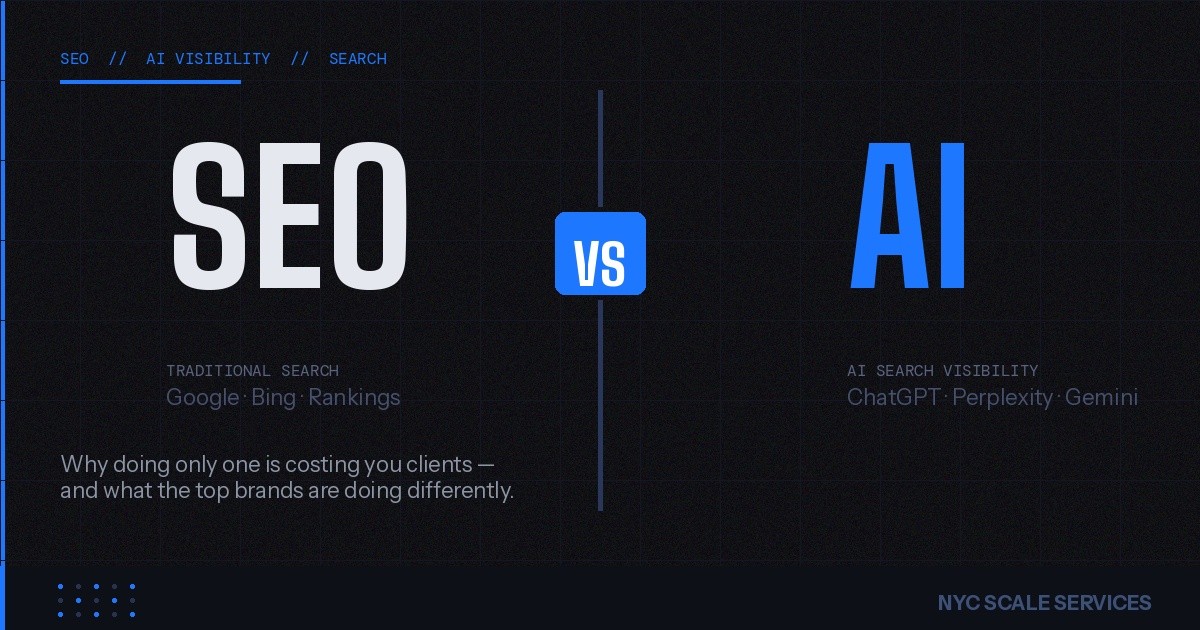
Search engines ruled the internet for two decades — but the way people find businesses online has fundamentally shifted, and most brands are still playing by the old rules while their competitors quietly take over.
Section
SEO Is No Longer Enough — Here's What's Replacing It
Most businesses are pouring money into SEO without realizing that half their potential clients are now finding answers through AI — and their website isn't showing up there at all.
When I first started learning digital marketing, SEO felt like cracking a secret code.
Get enough backlinks. Use the right keywords. Write enough content. And eventually — if you did everything right — Google would reward you with page one rankings, and the clients would follow.
For a long time, that's exactly how it worked. I watched small businesses go from invisible to fully booked just by cleaning up their SEO. It was powerful, and it still is. But something has shifted over the last couple of years that most small business owners haven't caught onto yet — and it's costing them leads every single day.
People are no longer just typing into Google.
They're asking ChatGPT. They're using Perplexity. They're letting AI tools do their research for them and trusting the answers they get back. And if your business isn't showing up in those answers, you're invisible to a massive and rapidly growing segment of your market — no matter how good your Google rankings are.
This is the conversation nobody in the small business world is having. So let's have it.
First, Let's Talk About What SEO Actually Is
If you're not deep in the marketing world, SEO can feel like a buzzword people throw around without really explaining. So let's keep it simple.
SEO stands for Search Engine Optimization. It's the process of making your website show up higher on Google when someone searches for something related to your business.
So if you run a dental practice in Brooklyn and someone searches "dentist near me" or "teeth whitening Brooklyn," good SEO means your website appears near the top of those results — ideally on page one, ideally in the first few spots.
Why does that matter? Because the higher you rank, the more people click on your website, and the more potential clients you get — without paying for ads.
SEO involves a lot of things: the words you use on your website, how fast your site loads, how many other websites link to yours, how often you publish helpful content, and how well your site is set up technically. It's not a one-time thing — it's an ongoing process that builds over time.
And for the past two decades, mastering SEO was essentially the whole game when it came to getting found online.
Until now.
What Is AI Search Visibility — And Why Does It Matter?
Here's what's changed.
Tools like ChatGPT, Perplexity, Google's AI Overviews, and Microsoft Copilot are now being used by millions of people every day to find information, get recommendations, and make buying decisions.
Instead of typing "best accountant for small businesses in New York" into Google and scrolling through results, someone might just ask ChatGPT: "Who are the best accountants for small businesses in New York?" And they'll trust whatever answer comes back.
That answer doesn't come from a list of ranked websites the way Google works. It comes from AI that has been trained on enormous amounts of online content — blog posts, directories, reviews, articles, social media — and synthesizes it all into a direct response.
Here's the critical part: if your business isn't being talked about, cited, or referenced across the internet in a credible way, AI tools won't mention you. You simply won't exist in that answer.
This is what we call AI Search Visibility — or more technically, GEO, which stands for Generative Engine Optimization. It's the practice of making sure your brand shows up not just on Google, but in the answers that AI tools generate for your potential clients.
SEO vs AI Search Visibility: What's the Difference?
Think of it this way.
SEO is about getting your website to rank on Google so people can find you when they search.
AI Search Visibility is about making sure AI tools know who you are, what you do, and why you're credible — so they mention you when someone asks them for a recommendation.
They're related, but they're not the same thing. And optimizing for one doesn't automatically mean you're optimized for the other.
Here's a simple breakdown:
Traditional SEO focuses on:
Keywords on your website
Backlinks from other sites
Technical website performance
Google rankings
AI Search Visibility focuses on:
Being cited and referenced across the internet
Publishing content that directly answers specific questions
Building authority and credibility that AI can recognize
Showing up in AI-generated answers and recommendations
The businesses that will dominate the next decade of search are the ones doing both — not just one.
Why Small Business Owners Are Getting Left Behind
Here's the hard truth: most small business owners are still playing the 2015 version of the game.
They're focused entirely on Google rankings. Some of them are doing it well. Some of them have invested real money into SEO and are seeing results. But almost none of them are thinking about what happens when their potential client doesn't go to Google at all.
And that's happening more and more every day.
A recent study found that a significant portion of online searches — particularly research-based and recommendation-based searches — are now being handled by AI tools rather than traditional search engines. That number is only going up.
Which means if you're only investing in SEO, you're optimizing for a shrinking piece of the pie.
The businesses showing up in AI answers right now aren't necessarily the biggest or the best-funded. They're the ones who started creating the right kind of content early. The ones who built genuine authority online. The ones who got ahead of the shift before everyone else caught on.
That window is still open — but it won't be forever.
What You Need to Do Right Now
The good news is that building AI search visibility doesn't require starting from scratch. A lot of what helps with traditional SEO also helps with GEO — but there are some specific things you need to add to your strategy.
1. Write content that answers real questions
AI tools are trained to answer questions. So the best way to show up in their answers is to publish content that directly and thoroughly answers the questions your potential clients are asking.
Not vague blog posts. Not keyword-stuffed articles. Real, helpful, specific answers to real questions your clients have — written in plain language that anyone can understand.
Think about what your clients ask you all the time. Those questions are your content strategy.
2. Build credibility across the internet
AI tools don't just look at your website. They look at everything — review sites, directories, industry publications, social media, other websites that mention you. The more your business is referenced in credible places across the internet, the more likely AI is to recognize you as an authority and include you in its answers.
This means getting listed in relevant directories, earning reviews on multiple platforms, getting mentioned in industry articles, and building a presence beyond just your own website.
3. Be specific about what you do and who you serve
Broad, generic positioning doesn't work well for AI search. If your website says you're "a marketing agency that helps businesses grow," that tells an AI tool almost nothing useful.
But if your content clearly and repeatedly states that you help small businesses in New York generate leads through web design, SEO, and paid advertising — that's something an AI can latch onto and reference when someone asks the right question.
Specificity is the currency of AI search visibility.
4. Don't abandon your SEO
This is important. AI search visibility doesn't replace SEO — it adds to it. Google is still the most widely used search engine in the world, and ranking well there still matters enormously.
The goal is to show up everywhere your potential clients are looking. That means Google and AI tools. Treating them as an either/or choice is a mistake.
5. Update your content regularly
AI tools favor content that is current, accurate, and frequently updated. A blog post from four years ago that's never been touched carries less weight than one that's been refreshed recently. Make it a habit to revisit and update your best content every few months.
The Bottom Line
Search is changing faster than most small business owners realize.
For twenty years, the formula was simple: rank on Google, get found, get clients. That formula still works — but it's no longer complete. A growing percentage of your potential clients are bypassing Google entirely and going straight to AI tools for their answers and recommendations.
If your business isn't showing up there, you're losing leads you don't even know exist.
The businesses that win over the next decade won't be the ones who mastered SEO in 2015 and never evolved. They'll be the ones who understood that the rules changed, adapted early, and built a presence everywhere their clients are searching — on Google, on AI tools, and everywhere in between.
At NYC Scale Services, this is exactly what we help small businesses do. We don't just optimize for Google — we build the kind of online authority and content strategy that gets you found across every platform your clients are using, including the AI tools that are rewriting the rules of search right now.
If you want to know where your business stands — and where you're being left behind — reach out for a free growth audit. We'll show you exactly what's working, what isn't, and what needs to change.
Because the brands that show up everywhere are the ones that win. And right now, most of your competitors aren't showing up everywhere.
That's your opportunity.
Mark Prakhin is the founder of NYC Scale Services, a full-service digital growth agency helping small businesses scale through web design, SEO, GEO, paid advertising, and branding.